Beat Tiles 2: Piano Master
- 3.7
- Rating
- 5.00M
- Installs
- Free
- Price

 Analysis by App-foxy
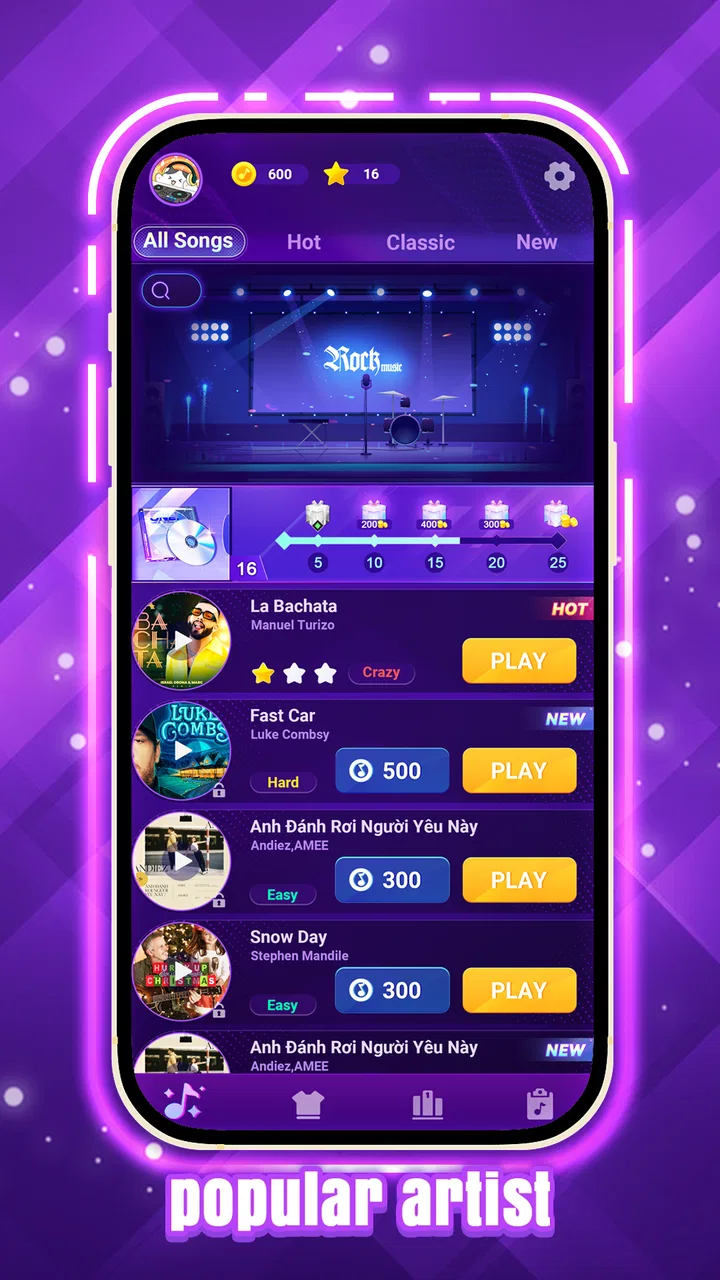
I spent time with Beat Tiles 2: Piano Master as the kind of game you open for a few spare minutes, not as a replacement for a full music-learning app. Its basic appeal is immediate: the screen turns into a compact piano-style play space, and the challenge is to keep your attention on the moving rhythm rather than treating the phone like a conventional game controller. That makes it easy to understand before it becomes easy to master.
JoyPop Games presents it as a free music game for Android, with an Everyone age rating and support beginning with Android 7.0. The current version is 1.3.3, and the game was released on February 20, 2025. Those details matter less than the way it fits into daily use, but they help explain its position: this is an accessible, lightweight-feeling rhythm experience aimed at casual players, not a serious instrument simulator.
Why the first week feels so inviting
My first impression was that the game asks very little from a new player. You do not need to understand a complicated interface before trying a song-like sequence. The piano framing gives the taps a clear purpose, while the rhythm-game structure supplies the pressure. I could pick it up, play a short session, put it down, and remember how to start again later without having to relearn a control scheme.
You May Also Like

 Blood Strike: 2.5 Anniversary
Blood Strike’s Loadouts Turn Every Drop Into a Tactical Gamble
A close look at Blood Strike’s custom loadouts: how fast access to signature weapons reshapes its battle royale rhythm, rewards preparation, and narrows the gap between fights.

 Pandora - Music & Podcasts
Pandora’s Music Is Easy to Start, but Harder to Recover
Pandora’s strength is its low-effort path from a seed to a station. Its weak spot is how much confidence it asks you to place in connection, setup, and quiet recovery.

 8 Ball Pool
 Is Built on Rivalries, Rematches, and Routine
A close look at the rivalries, rematches, shared routines, and unanswered safety questions that turn a quick pool match into a persistent mobile community.

 Samsung Music
’s Quiet Strength Is Playing What You Already Own
Its reach comes less from spectacle than from dependable access to a personal library. That simplicity is both the app’s strongest retention engine and its ceiling.

 AccuWeather: Weather Radar
AccuWeather Review: A Quick, Clear Forecast for Everyday Decisions
For everyday plans, the best forecast is the one you can understand quickly. AccuWeather makes rain timing, radar, and local conditions easy to act on, with a few trade-offs.

 Hill Climb Racing
Why Hill Climb Racing Still Turns Crashes Into One More Run
A tiny car, a bumpy hill and one more upgrade: Hill Climb Racing keeps resurfacing because its simple chaos makes every near-miss feel personal.
More From Our News Desk



That low entry barrier is the strongest part of the experience. A person waiting for a bus, taking a short break between tasks, or relaxing before bed can understand the attraction quickly. It also works well for someone who likes music games but does not want to commit to a long campaign. The free price removes the biggest obstacle to trying it, and the Everyone rating makes it suitable for a broad household audience.
The piano presentation is useful because it gives the game a recognizable identity without pretending to teach piano technique. I would not use it to learn fingering, scales, reading notation, or proper hand posture. The useful skill here is visual timing: seeing what is coming, deciding where to tap, and recovering when concentration slips. That distinction is important for parents and beginners who might otherwise expect an educational tool.
During the first few sessions, I recommend playing with a deliberate rhythm instead of tapping as quickly as possible. The instinct is to chase every tile with frantic fingers, but that can make mistakes harder to diagnose. When I slowed down mentally and watched the next sequence before reacting, the game felt more controlled. This is one of the small habits that separates an enjoyable session from a frustrating one.
Another practical tip is to treat the opening session as a calibration period. Try the game when your hands are relaxed, keep the phone steady, and avoid judging it based on a rushed attempt while multitasking. Rhythm games expose delayed reactions, screen-position habits, and attention problems very quickly. A poor first run may say more about the situation than about the game itself.
The early appeal also comes from its compact commitment. Unlike a traditional piano app, it does not require a quiet room, physical space, or an instrument. Unlike a large music game, it does not feel like something that demands a scheduled evening. That makes it especially convenient for short bursts, although the same simplicity later becomes part of the question about whether it deserves permanent space on a phone.
Who gets the most from the opening sessions
I think the best early audience is a casual player who enjoys quick reactions and musical presentation. It suits people who want a game that can be understood without reading a long tutorial, and it can be a pleasant introduction to rhythm games for someone who normally avoids complex controls. It is also a reasonable choice for families looking for something approachable rather than intense.
It is less suitable for a player searching for authentic piano practice. The piano theme may make the experience feel musical, but the core activity remains timing taps on a screen. Someone who wants to build real playing ability would be better served by an app designed around lessons, a virtual keyboard with note guidance, or an actual keyboard connected to a learning system.
It is also not the right first choice for people who need deep customization or a substantial progression structure. If your enjoyment depends on building a character, managing a collection, competing through detailed rankings, or unlocking a large set of systems, the straightforward design may feel thin once the initial novelty has passed.
What remains after the novelty fades
The more important test came after the first excitement. A rhythm game can be fun immediately and still fail to become a habit. In my experience, this one has recurring value when I use it as a short focus exercise rather than expecting it to provide an endless stream of new ideas. The appeal is repeatable timing practice, not a constantly expanding world.
That makes the game a better fit for a simple routine than for marathon play. A few attempts during a break can feel satisfying because the objective is clear and the session has a natural stopping point. I found that useful on days when I wanted a small distraction but did not want to begin a large game that would consume an hour.
A realistic everyday scenario is a ten-minute pause between work and dinner. I can play one or two rounds, notice whether my attention is sharp or scattered, and then close the app without feeling that I have abandoned a complicated task. On another day, the same session may feel repetitive, which is a reminder that its value depends heavily on my mood and tolerance for repeated timing challenges.
For month-to-month use, I would keep expectations modest. The game can remain a handy option if you enjoy replaying familiar rhythm patterns and trying to improve your consistency. It is less convincing as a single permanent entertainment app because the basic loop does not automatically create a reason to return every day. The long-term question is not whether it works; it is whether this particular kind of short challenge matches your habits.
One way to extend its usefulness is to assign it a specific role. I would use it as a warm-up before other music games, a quick concentration reset, or a low-effort activity when I am tired of scrolling. Giving it a job prevents the app from competing with every other game on the phone. Without that role, it is easy to open it repeatedly during the first week and then forget it.
Another useful trade-off is the difference between improvement and variety. If you enjoy improving reaction accuracy, repetition can be rewarding because small gains become noticeable to you even when the game itself stays familiar. If you mainly want fresh content, the same repetition can become a weakness. The game’s lasting value therefore depends more on your preferred type of challenge than on its music category alone.
How it compares with familiar alternatives
Compared with a standard piano-learning app, this is quicker and more playful but much less educational. A lesson-focused alternative is better when you want structured practice and musical understanding. Beat Tiles 2: Piano Master is better when you want the feeling of playing along without the preparation that real learning usually requires.
Compared with a conventional rhythm game, the piano framing makes the experience feel more focused and approachable. A larger rhythm title may offer more depth, stronger progression, or a wider sense of competition, while this game is easier to open for a brief session. I would choose this one when convenience matters more than a broad feature set.
Compared with casual puzzle games, it demands more continuous attention. You cannot rely on slow planning in the same way you might with a turn-based puzzle. That makes it a better choice when I want active engagement, but a worse choice when I am already mentally tired or looking for something relaxing rather than reactive.
Where routine use creates friction
The maintenance burden is relatively small in the practical sense: it is free, has a broad age rating, and does not ask me to learn a complicated control system before playing. Still, keeping any short-session game installed has a cost. It occupies attention, competes with other entertainment, and can become another icon opened automatically without much enjoyment.
The most important maintenance task is expectation management. I would not install it expecting a complete piano course, a deep music library, or a long-form adventure. If I judge it by those standards, the experience will feel limited. If I judge it as a compact timing game with a musical surface, its purpose becomes clearer and the decision to keep it becomes easier.
Storage and device compatibility are also worth considering in ordinary terms. The game supports Android 7.0 and later, so it is available to people using older supported Android devices. On any phone, though, the experience will depend on how comfortable the screen is for repeated tapping and how well the device handles quick visual feedback. A small display or a phone that is awkward to hold can make precision feel more tiring than it should.
I also recommend keeping sessions intentional if you are sensitive to repetitive tapping. A short break can be enjoyable, but repeated attempts after a disappointing run may turn the game into a cycle of frustration. When I notice myself playing only to erase a mistake rather than because I am enjoying the rhythm, that is the right moment to stop and return later.
There is a useful distinction between difficulty fatigue and content fatigue. Difficulty fatigue happens when the timing pressure makes your hands and attention feel worn out. Content fatigue happens when the same type of sequence no longer feels interesting. The first can often be solved with shorter sessions and better concentration; the second is a stronger sign that another game or a music-learning app may suit you better.
The reasons some players may move on
The average rating is 3.5 from around 2.2 thousand ratings, while the store shows 13 written reviews. I read that overall signal as mixed rather than alarming: the game clearly reaches a large audience, but its simple design will not satisfy everyone equally. More than 5 million installs show that the concept has broad reach, yet popularity does not guarantee long-term retention for every player.
Those figures are useful context, but my own concern is more practical. A game built around a narrow action can feel repetitive once the initial hand-eye challenge becomes familiar. Players who need frequent surprises may find that the piano presentation is not enough to keep the loop fresh. The experience can also be unforgiving in a way that is exciting at first and irritating when you are trying to play casually.
Another source of fatigue is the mismatch between the name and the likely expectation it creates. “Piano Master” sounds more comprehensive than a quick rhythm game. I would approach it as a piano-themed tapping challenge, not as a masterclass. That single adjustment makes the product easier to appreciate and avoids disappointment caused by expecting real musical instruction.
There is also a social trade-off. If you mainly enjoy games because of multiplayer interaction, shared progression, or a strong community layer, a solo rhythm experience may not hold your attention for long. On the other hand, its independence is an advantage when you want something that does not require coordinating with friends or waiting for other players.
For younger players, the accessible presentation is a positive, but adults should still pay attention to session length and frustration. The Everyone rating describes broad content suitability, not a guarantee that every child will enjoy the reaction demands. A child who likes music may prefer the theme, while a child who expects to freely play melodies may find the fixed challenge less expressive than a virtual keyboard.
Does it earn a lasting place?
My long-term verdict is cautiously positive, with a clear condition: keep it installed if you genuinely enjoy short, repeatable rhythm challenges. The free model and approachable design make it easy to recommend as a try-before-you-decide game. I can see it earning a regular place on a phone used for quick breaks, especially by someone who likes active concentration more than passive entertainment.
I would not recommend it as the only music app on a device. It does not replace learning software, a virtual instrument, or a richer rhythm game. Its strength is narrower and more honest: it turns a spare moment into a small timing exercise with a piano-like identity. That can be enough for the right player, but it should not be stretched into a promise of musical education or endless variety.
JoyPop Games has made something accessible, and the current version, 1.3.3, is easy to place in that casual space. The game’s lasting value comes from convenience, not complexity. If I am waiting, unwinding, or looking for a quick way to wake up my attention, I know what it offers. If I want a deeper sense of progress, a broader catalog of musical activities, or a reason to play for a long evening, I would choose a different option.
The best reason to download it is its low commitment; the best reason to uninstall it is repetition. I would give it a fair first week, use the deliberate-tapping approach, and then ask whether I am returning because the sessions still feel satisfying or simply because the icon is nearby. If the answer is genuine enjoyment, this free music game earns its space. If not, moving to a piano-learning app or a deeper rhythm title is the more sensible long-term choice.
FAQs for Beat Tiles 2: Piano Master
01What is Beat Tiles 2: Piano Master about?
Beat Tiles 2: Piano Master is a rhythm-based game where players tap tiles in sync with music tracks. It combines engaging gameplay with a wide selection of songs, offering an immersive experience for music lovers. Players can enjoy various genres while improving their reflex and timing skills.
02Is Beat Tiles 2: Piano Master free to play?
Yes, Beat Tiles 2: Piano Master is free to download and play. However, it offers in-app purchases, which include additional songs and premium features. These purchases are optional and meant to enhance the gaming experience, allowing players to access exclusive content and remove ads.
03What are the system requirements for Beat Tiles 2: Piano Master?
Beat Tiles 2: Piano Master requires Android version 5.0 or higher, or iOS 10.0 or later. It’s optimized for both smartphones and tablets, ensuring smooth performance across devices. Make sure your device meets these requirements for the best gameplay experience without any performance issues.
04Does Beat Tiles 2: Piano Master require an internet connection?
While Beat Tiles 2: Piano Master can be played offline, certain features like downloading new songs or accessing leaderboards require an internet connection. To fully enjoy all aspects of the game, including updates and additional content, occasional connectivity is recommended.
05How can I improve my skills in Beat Tiles 2: Piano Master?
Improving in Beat Tiles 2: Piano Master involves practice and rhythm awareness. Start with slower songs to get a feel for the timing, then gradually try faster tracks as your skills develop. Utilize practice modes, and replay challenging sections to enhance your reflexes and precision.
Pros
- Engaging and intuitive gameplay.
- Wide variety of songs available.
- Responsive touch controls.
- Visually appealing graphics.
- Frequent updates with new tracks.
Cons
- In-app purchases can be pricey.
- Ads may interrupt gameplay.
- Requires constant internet connection.
- Limited offline functionality.
- Occasional lag on older devices.

Beat Tiles 2: Piano Master
Gallery